
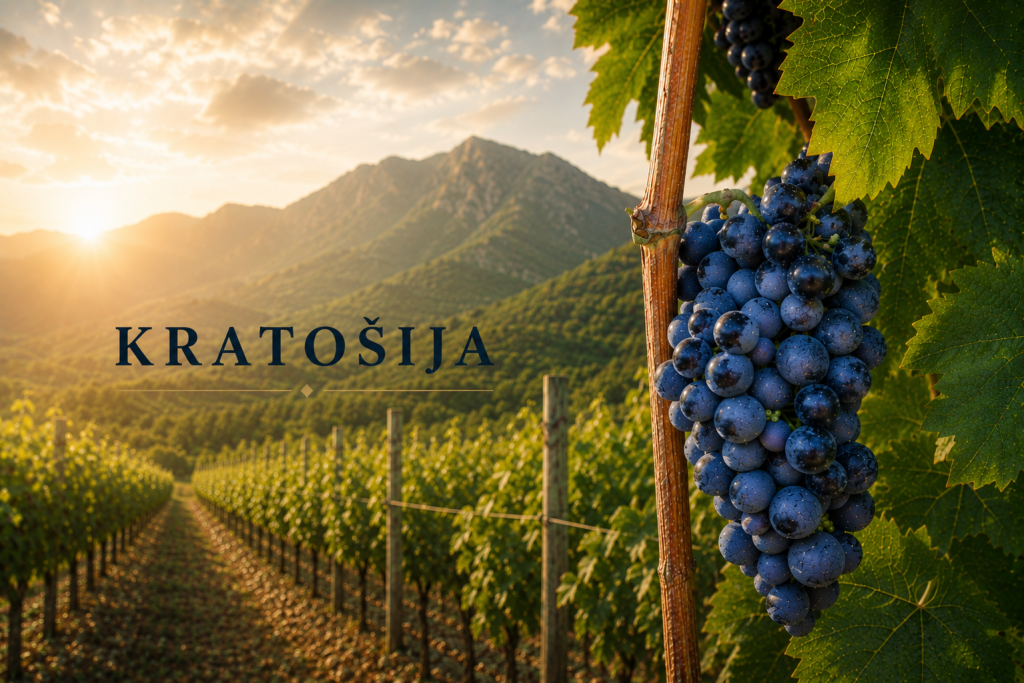
Every story about Montenegrin viticulture is practically unimaginable without mentioning Kratošija, a variety whose vineyards are referenced as early as the Statute of Budva from the 15th century.
It is one of the oldest indigenous grapevine varieties, which we can rightfully call the “mother” variety of Montenegrin viticulture, as it is the parent of almost 20 indigenous varieties, including Vranac, the symbol of Montenegrin wine.
Today, Kratošija is cultivated around the world under different names: as Zinfandel in America, Primitivo in Italy, and Crljenak Kaštelanski and Tribidrag in Croatia. Although it carries different names, it has the same genetic identity. For this reason, this variety has for decades been at the centre of attention of the global scientific community, as well as the wider wine scene, since the question of its origin was long the subject of debates, research and different interpretations.
The great popularity of American Zinfandel created the need to determine its true origin, which led to strong international interest. Over the years, different countries sought to prove that the roots of this variety lay within their territory, and scientific conclusions changed in line with the data available at the time. This search was not only the subject of scientific papers, but also of books, documentary films and numerous professional and popular discussions.
Although historical records of Kratošija had long existed in Montenegro, along with numerous ampelographic studies indicating its local character and spread from this area, the key confirmation came only with the development of modern genetic methods. The proof of an identical DNA profile of Kratošija, Zinfandel and Primitivo represented a turning point in the understanding of this variety in 2008.
On this basis, further international research was developed, involving the Development Sector of Plantaže, in cooperation with renowned scientific institutions from Italy and Spain. This research further confirmed that Montenegro is the most likely area of origin and the centre of genetic diversity of Kratošija.
The special significance of this variety is also reflected in its pronounced variability. A large number of Kratošija biotypes have been identified in Montenegro, indicating a long continuity of its cultivation and evolution precisely in this area. Such genetic diversity is not only proof of the variety’s historical presence, but also a valuable resource for the future development of viticulture.
Kratošija has a central role in the formation of Montenegro’s varietal assortment. As a parent variety, it participated in the creation of a large number of indigenous grapevine varieties, thereby directly influencing the shaping of Montenegro’s viticultural identity. For this reason, its significance goes beyond the framework of a single variety and becomes a matter of overall cultural and natural heritage.
In a broader context, the genetic resources of grapevine in Montenegro represent an exceptionally rich and valuable fund. The diversity among indigenous, domesticated and wild forms of grapevine provides a foundation for creating new varieties, improving wine quality and adapting to climate change. This potential is important not only for production, but also for science, sustainable development and the positioning of Montenegro on the global wine map.
Through systematic research, the preservation of genetic resources and the development of grapevine collections, Montenegro today confirms its role not only as a guardian of tradition, but also as an active participant in modern scientific and developmental trends in viticulture.
Wines produced from this variety have characteristic colours ranging from purple-red to ruby red.
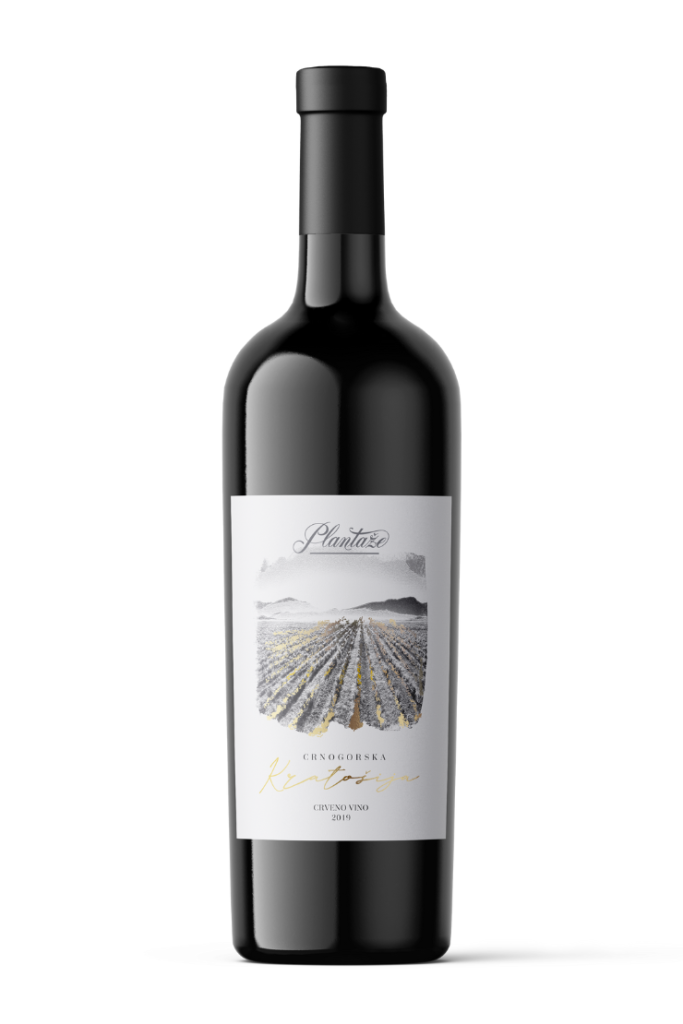
Among the aromas, we recognise both dark and red fruit — blackberry, blackcurrant, dried plum and sour cherry, overripe pomegranate — and sometimes spicy notes of black pepper and liquorice.
On the palate, it is full-bodied, with medium acidity and velvety tannins, especially after a few years of ageing in barrels, followed by a long, spicy finish.
Food pairing recommendation: meat goulash, veal skewers, Njeguši steak, roasted vegetables — where the fruitiness of the wine complements earthy notes — and sometimes mature cheeses such as Njeguši cheese.
It is served at a temperature of 15–18°C, for optimal harmony with Balkan and Mediterranean dishes.
Kratošija is more than a wine — it is a blend of tradition, history and authentic flavour that has endured for centuries.

Engleska verzija našeg novog sajta je trenutno u izradi.
Dok radovi ne budu završeni, staru verziju sajta na engleskom jeziku možete posjetiti putem linka:
The English version of our new website is currently under development.
In the meantime, you can visit the previous English version of the website using this link: