September is the time of harvesting and processing wine grapes. It is a period that winemakers eagerly await throughout the year, follow with anticipation and always welcome with immense joy.
In the following text, we will tell you more about how white wines are produced and which varieties Plantaže uses for the production of its white wines.
White wines are generally produced from white grape varieties, although this does not always have to be the rule. There are also white wines made from black grapes, using a process known as blanc de noir, meaning “white from black”. At Plantaže, all white wines are made from white grape varieties.
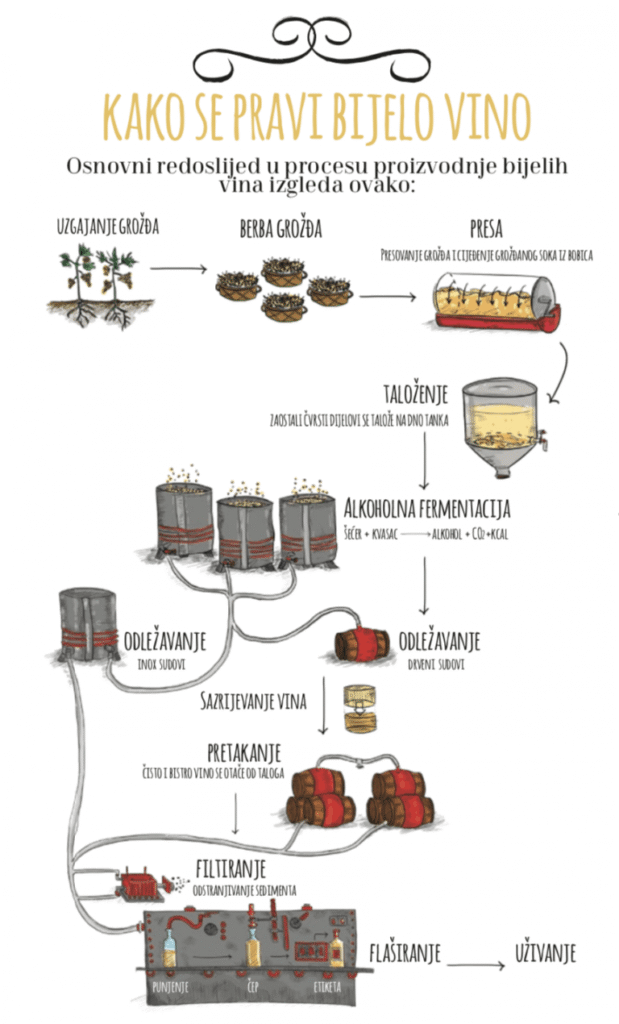
The basic sequence in the white wine production process is as follows:
White wines are consumed around the world almost as much as red wines. During warm summer days, their consumption is slightly higher than in winter. Lighter, younger and more vibrant wines can be served as an aperitif before a meal, but they can also be excellent companions to lighter food.
Fuller and more complex white wines have greater ageing potential and, when served, require a wider glass; quite often, they also benefit from decanting. These wines call for richer food and are served at a slightly higher temperature than light white wines. The recommended serving temperature for white wines is 9–11°C.
Why Do Some White Wines Seem Creamy?
After fermentation is complete, some wines undergo what is known as malolactic fermentation, during which malic acid is converted into lactic acid, giving the wine a buttery and creamy taste.
The caloric value of white wines is around 121 kcal per glass — 0.15 l.
At the company “13. Jul – Plantaže”, white wines are produced from the varieties Krstač, Žižak, Chardonnay, Sauvignon Blanc, Pinot Blanc and Malvasia.
Krstač
Krstača Bijela, Bijeli Krstač, Krsta Bijela, Loza Bijela, Bioka
Krstač is a white indigenous Montenegrin wine variety that has long been cultivated in the vineyards of the Podgorica wine-growing region, and is used in the production of quality white wines. It most likely originates from Beri, near Podgorica.
The name of the variety comes from the appearance and shape of the cluster, which resembles a cross. In the late 1950s, in the Lake Skadar region, within the Podgorica subregion — Beri and Doljani — Krstač was the dominant variety for the production of white wines and was considered a characteristic variety of this region.
Later, during the 1960s and 1970s, it was cultivated as the main white wine variety in the vineyards of the Bjelopavlići Plain, Zeta and Lješkopolje, although the cultivation area of this variety did not exceed 40–50 km.
Žižak
Žižak is an indigenous Montenegrin variety used for the production of white wines. Until recently, it was not very widespread in Montenegro. Individual vines could be found near Podgorica and Crmnica, while it was cultivated mostly on the Montenegrin coast.
In the Bay of Kotor, the Žižak variety is known under the synonym Žižak Bijeli and was used for the production of prosecco-style sparkling wine. In recent years, interest in this variety has been growing, and the vineyard area planted with Žižak in Montenegro is gradually increasing.
Chardonnay
Chardonnay is the most famous and widespread white wine variety in the world. It belongs to the Pinot group of varieties and was created by crossing Pinot Blanc and Gouais Blanc. It originates from France, and due to its very good adaptability to growing conditions, it is cultivated in wine-growing regions around the world.
Many agree that there is no wine grape variety capable of offering such a wide and diverse range of wines as Chardonnay. As in many countries around the world, and therefore also in Montenegro, Chardonnay has been successfully cultivated for many years and is used for the production of different types of wine.
Depending on growing conditions and the method of vinification, the wines may be aromatic, with moderate acidity, but also creamy if malolactic fermentation is carried out and the wine is aged in oak barrels.
Sauvignon Blanc
Alongside Chardonnay, Sauvignon Blanc is the best-known French white variety. It originates from the Loire Valley in France, and is believed to have been created by crossing Traminer and Chenin Blanc. Today, it is cultivated in every wine-producing country.
Depending on the region in which it is grown, it produces premium wines in different styles, from dry to sweet. Wines made from this variety are characterised by freshness, fruity aromas and pleasant acidity, which is why they are mostly consumed young.
In Montenegro, it has been cultivated more extensively since 1998 and, together with Chardonnay, is one of the most represented introduced white wine varieties in the country.
Pinot Blanc
Pinot Blanc is a white wine variety originating from France and represents a genetic mutation of Pinot Noir. It is cultivated in many regions across Europe, especially in Italy, France, Germany and Slovakia. In Germany, it is known as Weissburgunder — White Burgundy.
It is used for the production of dry, sparkling and sweet wines. In recent years, Plantaže has used it to produce one of the company’s finest white wines — Pro Anima Pinot Blanc. Wine made from this variety is refreshing, with aromas of apple and pineapple and moderate acidity.
Malvasia Aromatica
Malvasia is the name given to a large number of different wine varieties cultivated across the Mediterranean, with the name usually supplemented by the region of cultivation. The term also refers to sweet and highly aromatic Malvasia wines, which may be produced from a single variety or from a blend.
It is believed to originate from Greece, while it gained worldwide fame thanks to Venetian merchants, who traded Malvasia wine from the 13th century onwards.
Malvasia wines are fresh, with fruity aromas of apple and apricot. At Ćemovsko Polje, Malvasia has been successfully cultivated since 2007.

Engleska verzija našeg novog sajta je trenutno u izradi.
Dok radovi ne budu završeni, staru verziju sajta na engleskom jeziku možete posjetiti putem linka:
The English version of our new website is currently under development.
In the meantime, you can visit the previous English version of the website using this link: